Chromatographic Quality Control: Detecting Salt-Form Adulteration in Synthetic Retatrutide Batches
An orthogonal quality-control framework for retatrutide identity, purity, counterion characterization and traceable third-party batch records.
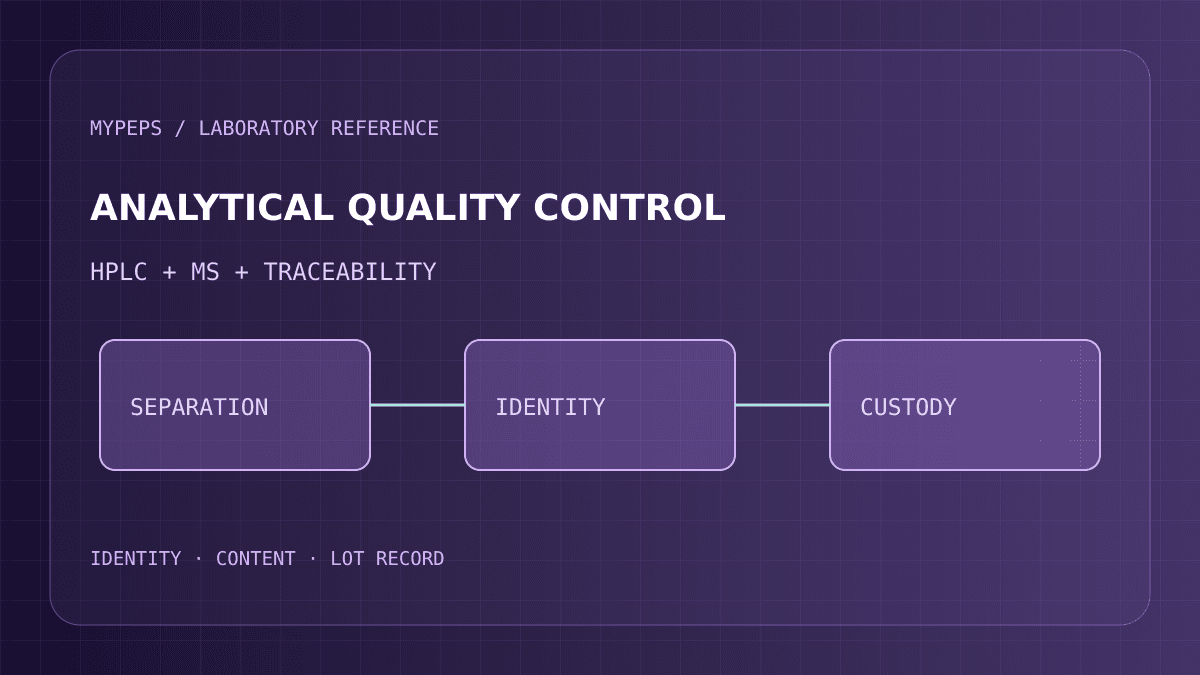
Establish the correct identity baseline
A quality investigation begins with the specified molecular structure. KEGG lists retatrutide as C221H342N46O68, with an average molecular weight of 4731.34 g/mol and a monoisotopic exact mass of 4728.4718 Da. The proposed value 4261.7 Da is not the baseline for this complete structure.
Average molecular weight, neutral monoisotopic mass and an instrument’s observed mass-to-charge ratio are different quantities. Electrospray produces charge states and may produce adducts; compare a properly interpreted spectrum with the expected molecular species and the method’s uncertainty.
A counterion difference requires characterization against the agreed specification. It may change gross mass, content and handling without changing the peptide backbone. Establish an out-of-specification result before labeling a material adulterated or counterfeit.
Analytical baseline and investigation matrix
| Analytical dimension | Expected baseline | Potential red flag | Confirmatory action |
|---|---|---|---|
| Chromatographic purity | At least 99.0% only when adopted as the agreed, method-defined specification | Unexpected peaks, shoulders or inconsistent integrations | Repeat a suitable method and examine system suitability and co-elution |
| Molecular identity | Structure-consistent mass; neutral exact mass 4728.4718 Da | Incompatible deconvoluted mass or unexplained adduct assignment | Verify charge states, calibration and orthogonal identity data |
| Average molecular weight | 4731.34 g/mol for the KEGG formula | Confusing average mass with a monoisotopic ion | Document formula, modification state and mass convention |
| Content | Measured analyte content consistent with the agreed specification | High area purity but unexpectedly low content | Use a suitable quantitative assay and assess water and counterions |
| Salt / counterion | Declared and characterized form | Undeclared or out-of-specification counterion levels | Apply appropriate counterion analysis; do not infer from HPLC alone |
| Traceability | Report, submitted sample and supplied lot reconciled | Task number valid but lot association unsupported | Request sampling and chain-of-custody documentation |
What HPLC and MS establish—and what they do not
Chromatographic assessment
HPLC separates components under specified conditions. Relative peak-area purity depends on wavelength, separation, integration rules and detector response. A dominant peak may conceal co-eluting material, and non-detected substances may contribute to gross vial mass. Area purity is not automatically mass fraction or vial content.
Mass spectrometric assessment
MS supports molecular-mass and identity assessment after appropriate interpretation. An intact mass consistent with the target does not independently prove every sequence position, stereochemistry or modification site. Where necessary, use fragmentation, peptide mapping or other suitable orthogonal methods.
Counterions and content
Use methods appropriate to the question, such as ion chromatography for relevant counterions, water determination and a validated content assay. Distinguish chemical identity, peptide content and the total mass of the preparation. Neither routine HPLC nor intact-mass MS alone establishes sterility, endotoxin compliance or suitability for clinical use.
Independent records and provenance review
A third-party registry can authenticate that a published task record corresponds to the laboratory’s reference. Check the task number and verification key at the laboratory’s original website; compare the sample description, analysis date, reported results and any batch identifier with the supplier’s documentation.
- Preserve the original report URL and the record reviewed at procurement.
- Reconcile the tested sample with the supplied lot rather than assuming every pack or strength is covered.
- Document who selected and submitted the sample and how its identity was preserved.
- Apply risk-based incoming testing where sample representativeness or chain of custody is uncertain.
- Investigate discrepancies through controlled records rather than treating an edited image as definitive evidence.
Janoshik reference verification is useful evidence, but it is not a cryptographic guarantee of the supplied vial’s identity and is not the only reliable provenance control. Independent analytical testing, representative sampling and documented custody complement registry checks.
A qualifying chromatographic result and valid task number are inputs to an institutional acceptance decision. They do not replace the laboratory’s specification, sampling plan or responsibility to investigate discrepancies.
Primary references and applicability
- KEGG D12430: formula and mass conventions
- Bachem: analytical quality control
- Bachem: peptide analytical FAQ
- Janoshik: original record verification
References reviewed 8 October 2026. Original reports and validated institutional procedures govern material-specific decisions.