Volumetric Reconstitution and Diluent Calibration for High-Dose 12mg Retatrutide Lyophilized Cakes
Laboratory concentration arithmetic for nominal 12 mg materials, with final-volume controls, diluent compatibility limits and device calibration boundaries.
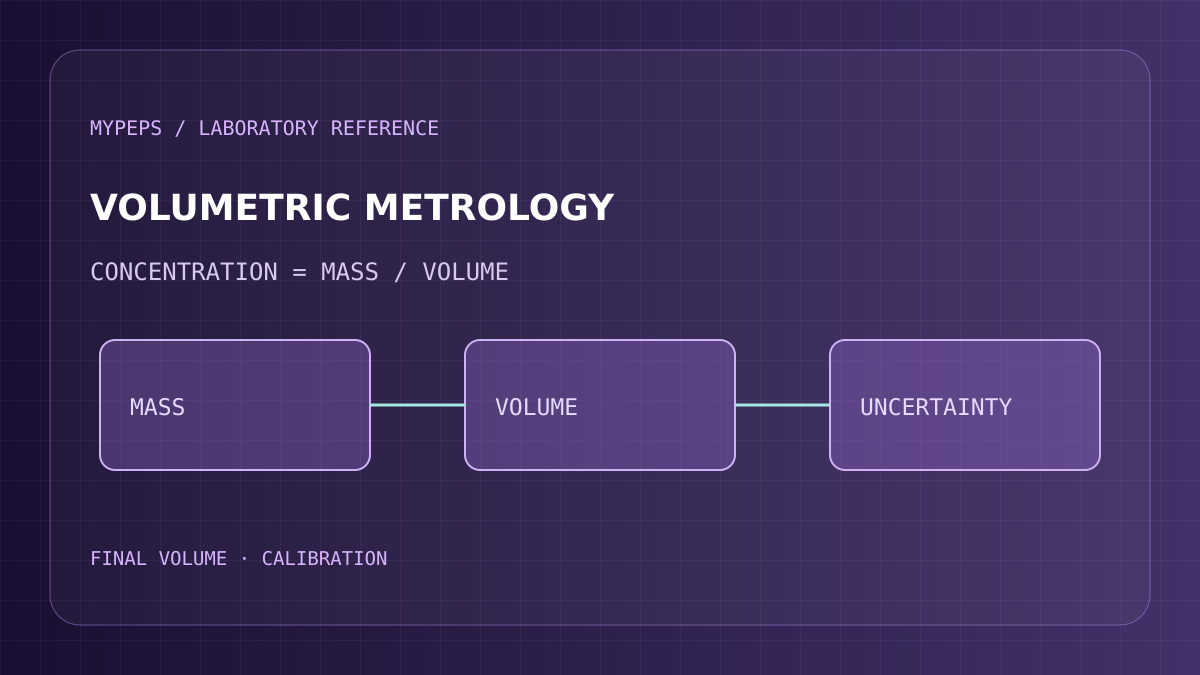
Define the mass and final volume
Here, 12 mg denotes nominal research-material content, not a therapeutic dose. A lyophilized cake may contain excipients, water and counterions; total cake mass is not automatically analyte mass. Use an appropriate content assay when quantitative accuracy is required.
- Analyte mass, m
- The mass of the specified analyte, preferably supported by measured content rather than only a nominal label.
- Final solution volume, V
- The volume after dissolution and any validated volume adjustment. It is not necessarily identical to the volume of solvent added.
- Mass concentration, c
- c = m / V, expressed in mg/mL. This is concentration, not bulk fluid density.
The following values are idealized arithmetic for a nominal 12 mg analyte mass. They do not validate a diluent, establish a storage period or specify administration.
Nominal concentration matrix
| Nominal analyte mass | Added diluent volume | Concentration if final volume equals added volume | Required micro-dial setting on a 3 mL device |
|---|---|---|---|
| 12 mg | 1.2 mL | 12 / 1.2 = 10 mg/mL | Not derivable: validated volume-per-increment calibration required |
| 12 mg | 2.4 mL | 12 / 2.4 = 5 mg/mL | Not derivable: device-specific calibration required |
| 12 mg | 3.0 mL | 12 / 3.0 = 4 mg/mL | Not derivable: capacity does not specify increment volume |
Worked calculations
- Target 10 mg/mL: V = 12 mg / (10 mg/mL) = 1.2 mL final volume.
- Target 5 mg/mL: V = 12 mg / (5 mg/mL) = 2.4 mL final volume.
- Target 4 mg/mL: V = 12 mg / (4 mg/mL) = 3.0 mL final volume.
For a measured mass different from 12 mg, recalculate each target. If dissolution changes the final volume, use the measured final volume rather than silently equating it to the solvent addition.
Diluent compatibility and handling controls
Bacteriostatic water formulations containing 0.9% benzyl alcohol contain 9 mg/mL of that preservative. This composition is not a universal peptide solvent specification. Compatibility depends on the compound, pH, excipients, assay and intended laboratory workflow. Preservative presence does not establish a validated sterile research preparation.
- Review the material-specific supplier instructions and institutional method before selecting a solvent.
- Record nominal and measured analyte content, solvent composition and the target final volume.
- Use calibrated volumetric equipment appropriate to the target volume and uncertainty.
- Apply the validated dissolution and mixing procedure; inspect for incomplete dissolution or visible particulate matter.
- Record final volume, preparation identifier and any analytical verification before using the stock in an assay.
Foam, interfaces and mechanical stress
Excessive agitation can introduce foam and increase air–liquid interfacial exposure. Some peptides or formulations may exhibit adsorption, aggregation or other changes under mechanical stress. Do not claim that every instance of shaking cleaves peptide chains. Assess handling sensitivity experimentally and follow the validated preparation procedure.
Device metrology is separate from concentration arithmetic
An adjustable device described as having a 3 mL capacity does not disclose delivered volume per dial increment, dead volume, precision, cartridge compatibility or fluid-dependent performance. Those quantities require manufacturer specifications and independent calibration appropriate to the laboratory workflow.
- Capacity
- A reservoir limit, not a calibration factor.
- Increment calibration
- Measured delivered volume for a defined dial movement under specified test conditions.
- Uncertainty budget
- Include analyte content, final-volume measurement, device delivery variability and losses from adsorption or incomplete dissolution.
This article deliberately supplies no click counts, administration volumes or therapeutic settings. Concentration calculations cannot substitute for device calibration.
Primary references and applicability
- Bachem: peptide content and concentration
- Sigma-Aldrich: peptide solubility
- DailyMed: bacteriostatic water composition
References reviewed 8 October 2026. Original reports and validated institutional procedures govern material-specific decisions.