The Path to Commercialization: Tracking the Q1 2027 Biologics License Application (BLA) Timeline for Retatrutide
A source-linked regulatory planning framework separating sponsor submission targets, FDA review milestones and analytical manufacturing readiness.
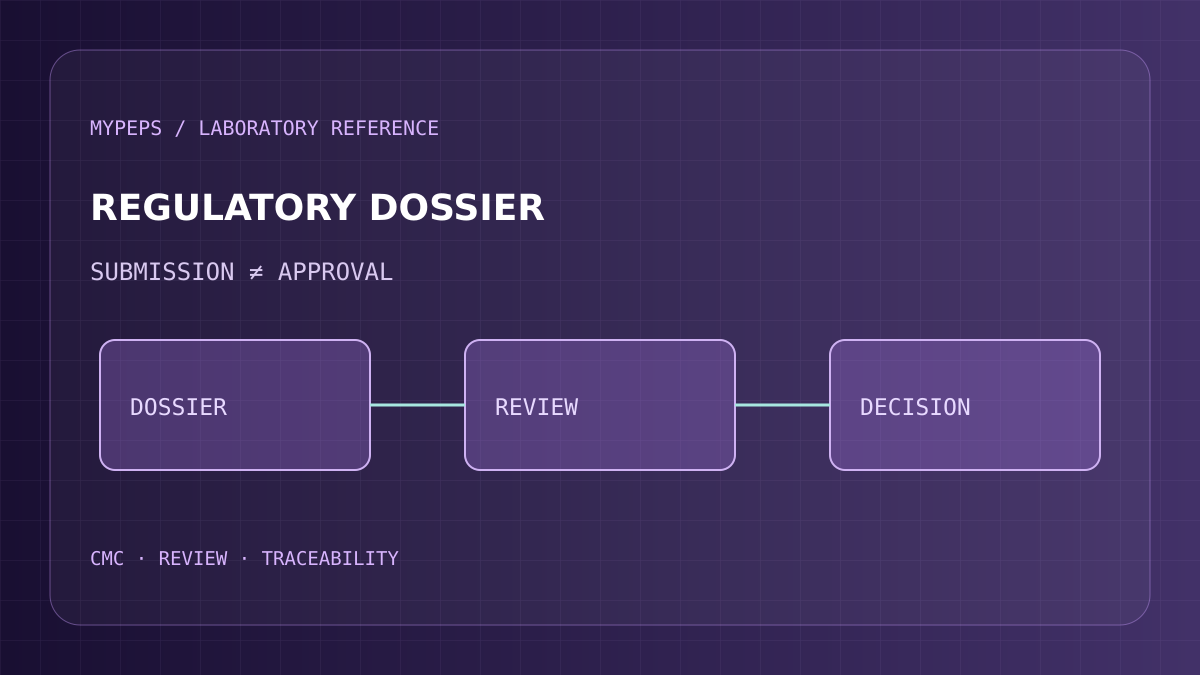
Submission target and regulatory status
As reviewed on 8 October 2026, Lilly has described a planned Q1 2027 Biologics License Application submission for retatrutide. A sponsor target is a forward-looking operational milestone. It is not an accepted application, assigned review designation, authorization or guaranteed decision date.
Research-material availability does not establish regulatory approval, equivalence to an investigational formulation or eligibility for clinical administration. This reference does not predict commercial availability.
Three separate events
- Submission: the sponsor transmits a dossier.
- Filing assessment: FDA evaluates whether the application is sufficiently complete for substantive review.
- Action: the agency may approve, request further information or issue a complete response requiring additional work.
Regulatory milestone matrix
| Quarter | Milestone | Evidence status | Interpretation |
|---|---|---|---|
| Q2 2026 | TRIUMPH-1 topline disclosure | Sponsor-reported | Endpoint disclosure is distinct from completion of the regulatory dossier. |
| Q3 2026 | Additional Phase 3 disclosures and submission planning | Sponsor-reported | Manufacturing and clinical modules still require integration. |
| Q1 2027 | Planned BLA submission | Forward-looking sponsor target | Timing remains subject to dossier readiness. |
| Q2 2027 | Possible filing assessment after a Q1 submission | Conditional planning scenario | Do not assign an FDA goal date before official acknowledgement. |
| Q3–Q4 2027 | Potential substantive review and inspection activity | Conditional | Requests, inspections and amendments may change the schedule. |
| Late 2027 / early 2028 or later | Possible agency action | No confirmed action date | Depends on submission timing, review designation and outstanding issues. |
FDA describes six-month priority and ten-month standard review goals. For relevant original applications under the review program, the clock can be measured from the 60-day filing date rather than the initial transmission date. These are review goals, not approval guarantees; priority designation must not be assumed.
Manufacturing architecture of a modified peptide
The published discovery record describes a modified 39-residue peptide incorporating non-standard residues, a C-terminal amide and a lipid-bearing side-chain modification. Identity control must cover the complete modified structure rather than only the linear amino-acid backbone.
- Sequence integrity
- Control deletion sequences, incomplete incorporation, epimerization and modification-related impurities with suitable orthogonal methods.
- Terminal and side-chain chemistry
- Confirm terminal functionality, attachment site and modification completeness; a chromatographic percentage cannot independently establish these features.
- Purification recovery
- Evaluate impurity resolution, recovered content and process consistency together. High area purity with poor content recovery is not an adequate release specification.
- Scale transfer
- Demonstrate that mixing, mass transfer, purification loading and holding conditions remain controlled when equipment and batch size change.
Quality readiness for institutional supply
Analytical specifications precede volume expansion
A manufacturing program needs validated identity and content methods, an impurity control strategy, stability evidence and documented change control. Laboratory synthesis capability alone does not establish readiness for regulated commercial manufacture.
- Define which measurement is chromatographic area purity, peptide content, water or counterion content.
- Trace raw materials, process intermediates, analytical samples and released lots through durable identifiers.
- Qualify reference standards and assess method suitability across sites and instruments.
- Document residual solvents, degradation products and microbiological attributes where applicable to the intended product.
- Separate supplier COAs from evidence of regulatory compliance or approval.
MyPeps batch references support document review for research procurement. They do not replace a sponsor’s chemistry, manufacturing and controls dossier or establish comparability to its investigational material.
Primary references and applicability
- Lilly: additional Phase 3 results and submission planning
- FDA: priority review
- FDA: review desk reference
- Coskun et al.: discovery and characterization
References reviewed 8 October 2026. Original reports and validated institutional procedures govern material-specific decisions.